

Whether you’ve just moved into a new apartment, want to save money on a gym membership, or simply prefer to work out in your comfort zone, you’re not alone. Millions of Americans are choosing the best home workouts over expensive gym memberships in 2026. If you’re a beginner just starting out and don’t know where to begin, this complete guide to the best home workouts for beginners was written just for you.
At Ant & Bees, we’ll tell you about the best home workouts for beginners, show you how to create your first home workout routine, give you a solid beginner’s workout plan for the week, and tell you everything you need to know to stay regular and see real results – all without expensive equipment.
Why the Best Home Workouts Are Perfect for Beginners in 2026
The fitness industry has changed dramatically. With the rise of online training apps, YouTube fitness channels, and wearable tech, doing a workout at home USA-style has never been more effective or accessible. Here is why starting your fitness journey at home makes perfect sense:
- No gym anxiety: Beginners often feel self-conscious in gym environments. At home, you are free to learn at your own pace.
- Zero commute time: Save 30–60 minutes a day by skipping the drive to the gym.
- Cost-effective: Most beginner workout plans require zero equipment.
- Flexible scheduling: Work out at 6 AM or 10 PM — your home gym is always open.
According to the American College of Sports Medicine, home exercise programs show similar effectiveness and results compared to gym programs, especially for beginners who are still building habits. This means you don’t have to wait until you feel “ready” for the gym – you can start building real strength and endurance right there.
These are truly the best home workouts for beginners because they eliminate barriers and let you focus purely on building strength and consistency.
What You Need for the Best Home Workouts (Beginners Need Almost Nothing!)
The great news? You need very little to get started. Here is a simple checklist:
- A clear space of at least 6×6 feet (your living room works great)
- Comfortable workout clothes and a good pair of sneakers
- A yoga mat (optional but helpful for floor exercises)
- Water bottle to stay hydrated
- A phone or laptop to follow along with workout videos or this guide
Optional additions as you progress: resistance bands ($10–$20), a set of light dumbbells (5–15 lbs), and a pull-up bar for your door frame. But for now, your own bodyweight is your best tool.
The Best Home Workout Exercises for Beginners
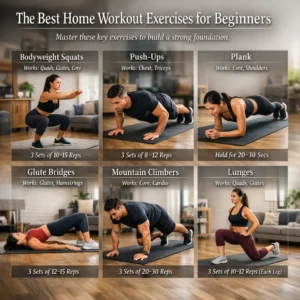
Before we get into your weekly beginner workout plan, let us break down the best home workout exercises for beginners you should master first. These movements represent the best home workouts because they’re safe, scalable, equipment-free, and proven to build a strong foundation.
1. Bodyweight Squats
Muscles worked: Quads, glutes, hamstrings, core
Squats are the king of lower body exercises. Stand with feet shoulder-width apart, push your hips back like you’re sitting into a chair, lower until your thighs are parallel to the floor, then drive back up. Keep your chest tall and knees tracking over your toes. Aim for 3 sets of 10–15 reps as a beginner.
2. Push-Ups
Muscles worked: Chest, triceps, shoulders, core
Push-ups are the ultimate upper body exercise. If you cannot do a full push-up yet, start with knee push-ups. Place your hands slightly wider than shoulder-width, lower your chest to the floor, and push back up. Keep your core tight and back flat the entire time. Beginners should aim for 3 sets of 8–12 reps.
3. Plank
Muscles worked: Core, shoulders, glutes
Planks build the core strength that supports every other movement. Get into a push-up position but rest on your forearms instead of your hands. Hold your body in a straight line from head to heels. Start with 20–30 second holds and work up to 60+ seconds over time.
4. Glute Bridges
Muscles worked: Glutes, hamstrings, lower back
Lie on your back with knees bent and feet flat on the floor, hip-width apart. Press through your heels to lift your hips until your body forms a straight line from knees to shoulders. Squeeze your glutes at the top and slowly lower back down. Great for activating the posterior chain and preventing lower back pain.
5. Mountain Climbers
Muscles worked: Core, cardio, full body
Start in a high plank position. Drive one knee toward your chest, then quickly switch legs in a running motion. Keep your hips level and core engaged. This move doubles as both a strength and cardio exercise, making it perfect for a home workout routine when you want to maximize calorie burn.
6. Lunges
Muscles worked: Quads, glutes, hamstrings, balance
Step forward with one foot and lower your back knee toward the floor. Keep your front knee over your ankle and your chest upright. Push back to the starting position and repeat on the other side. Lunges also improve balance and coordination, which is especially valuable for beginners.
These 6 exercises form the foundation of the best home workouts for beginners. Master these movements, and you’ll have everything you need to build strength, burn fat, and transform your body—all from the comfort of your living room.
Your Complete Beginner Workout Plan: 7-Day Home Schedule
This beginner workout plan is designed for those just starting out – no prior fitness experience is necessary. It balances work and recovery, and targets specific muscle groups throughout the week. Each session takes 25–40 minutes.
| Day | Focus | Key Exercises | Duration |
| Monday | Full Body Strength | Squats, Push-Ups, Plank, Glute Bridges | 30 min |
| Tuesday | Active Recovery | Light Walking, Stretching, Yoga | 20–30 min |
| Wednesday | Cardio + Core | Mountain Climbers, Jumping Jacks, Crunches | 25 min |
| Thursday | Lower Body Focus | Lunges, Squats, Glute Bridges, Calf Raises | 30 min |
| Friday | Upper Body Focus | Push-Ups, Tricep Dips, Shoulder Taps, Planks | 30 min |
| Saturday | Full Body Circuit | All 6 exercises in circuit format (AMRAP) | 35–40 min |
| Sunday | Rest & Stretch | Full Body Stretching & Mobility Work | 15–20 min |
Pro Tip: Rest 60–90 seconds between sets. As a beginner, consistency beats intensity every time.
How to Build the Best Home Workout Routine That Lasts
A workout plan only works if you actually stick to it. Here are Ant and Bees’ top strategies for building a home workout routine that lasts:
- Schedule it like a meeting: Block off your workout time in your calendar. Treat it as a non-negotiable appointment with yourself.
- Start small and build: Three days per week is a perfect start. Add a fourth day once three feels comfortable.
- Track your progress: Use a simple notebook or free app to log your reps and sets. Seeing progress is one of the most powerful motivators.
- Create a dedicated space: Even clearing a small corner of your living room signals to your brain that it is workout time.
- Progressive overload: Gradually increase reps, sets, or exercise difficulty every 1–2 weeks to keep making progress.
Best Home Workouts for Beginners: Common Mistakes That Kill Results
Many beginners in the USA who start their workout at home journey make the same avoidable mistakes. Here is what to watch out for:
- Skipping warm-up: Always spend 5 minutes walking in place, doing arm circles, or light dynamic stretches before any workout.
- Poor form for speed: It is far better to do 8 perfect squats than 20 sloppy ones. Focus on technique first, speed later.
- Not resting enough: Recovery is where your muscles actually grow. Never skip your rest days.
- Ignoring nutrition: Exercise and diet go hand-in-hand. Fuel your workouts with balanced meals and adequate protein.
- Expecting overnight results: Fitness is a long game. Stick to your beginner workout plan for at least 8–12 weeks before judging results.

Fueling the Best Home Workouts: Beginner Nutrition Guide
You cannot out-train a bad diet. Here is a simple beginner nutrition framework to support your home workout routine:
- Protein: Aim for 0.7–1g of protein per pound of bodyweight. Good sources: chicken, eggs, Greek yogurt, beans, and tofu.
- Carbohydrates: Do not fear carbs — they are your body’s preferred energy source. Whole grains, oats, fruits, and sweet potatoes are excellent choices.
- Healthy Fats: Include avocados, olive oil, nuts, and seeds for hormone support and joint health.
- Hydration: Drink at least 8 cups of water per day. Increase this on workout days.
- Pre-workout meal: A banana with peanut butter or a small bowl of oatmeal 60–90 minutes before your workout gives you sustained energy.
How to Progress Your Beginner Workout Plan Over Time
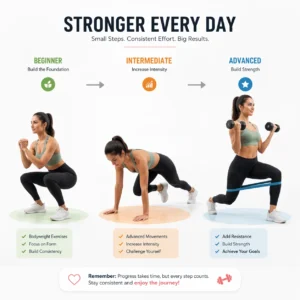
The body adapts quickly. Once the exercises start feeling easier, it is time to level up. Here is how to progress your home workout routine safely:
- Weeks 1–4: Master the 6 foundational exercises with correct form. Focus on 3 days per week.
- Weeks 5–8: Increase reps and sets. Add a fourth training day. Try harder variations (e.g., jump squats, decline push-ups).
- Weeks 9–12: Introduce resistance bands or light dumbbells. Experiment with supersets (doing two exercises back-to-back).
- After 12 weeks: Consider moving to an intermediate program. You will now have a strong foundation of strength, endurance, and body awareness.
Final Words: Your Fitness Journey Starts Today
Starting a home workout routine as a beginner might feel overwhelming, but remember — every fitness expert was once exactly where you are right now. The most important step is simply to begin.
With the beginner workout plan laid out in this guide, you have everything you need to build real, lasting fitness from the comfort of your home. You do not need a gym, expensive equipment, or a personal trainer to get started. You just need consistency, patience, and the willingness to show up for yourself every day.
At Ant and Bees, we believe that fitness is for everyone — regardless of age, fitness level, or budget. Whether you are doing your very first push-up or working toward your 100th, we are here to support every step of your journey.
So roll out your mat, lace up your sneakers, and take that first step. Your best self is waiting — and it starts with your very first workout at home.
Frequently Asked Questions: Best Home Workouts for Beginners
Can beginners really build muscle with home workouts?
Yes! Beginners can absolutely build muscle with bodyweight exercises at home. The key is progressive overload—gradually increasing reps, sets, or difficulty over time. Studies show that bodyweight training is just as effective as gym training for beginners in the first 6-12 months.
How long should a beginner workout at home?
Beginners should start with 25-30 minute workouts, 3 days per week. As you build endurance, you can increase to 40-45 minutes, 4-5 days per week. Quality and consistency matter more than duration.
What time of day is best for home workouts?
The best time is whenever you’ll actually do it consistently. Morning workouts (6-8 AM) boost metabolism for the day, while evening workouts (5-7 PM) can help with stress relief. Choose what fits your schedule.
Do I need equipment for the best home workouts?
No! The best home workouts for beginners require zero equipment. Bodyweight exercises like squats, push-ups, and planks are incredibly effective. As you progress (after 8-12 weeks), resistance bands or light dumbbells can be added.
How soon will I see results from home workouts?
Most beginners notice increased energy within 1-2 weeks, strength improvements in 3-4 weeks, and visible body changes in 6-8 weeks with consistent training and proper nutrition.
Can I lose weight with home workouts only?
Yes, but diet is crucial. Home workouts burn calories and build muscle, but weight loss requires a calorie deficit. Combine your workout routine with balanced nutrition for best results.
What’s better for beginners: full body or split workouts?
Full body workouts 3-4 times per week are ideal for beginners. They allow more recovery time and help you learn fundamental movements faster. Split routines are better for intermediate/advanced levels.
How do I stay motivated for home workouts?
Track your progress with our free PDF tracker, set specific goals, work out at the same time daily, and celebrate small wins. Having a dedicated workout space at home also helps maintain consistency.






Be First to Comment